
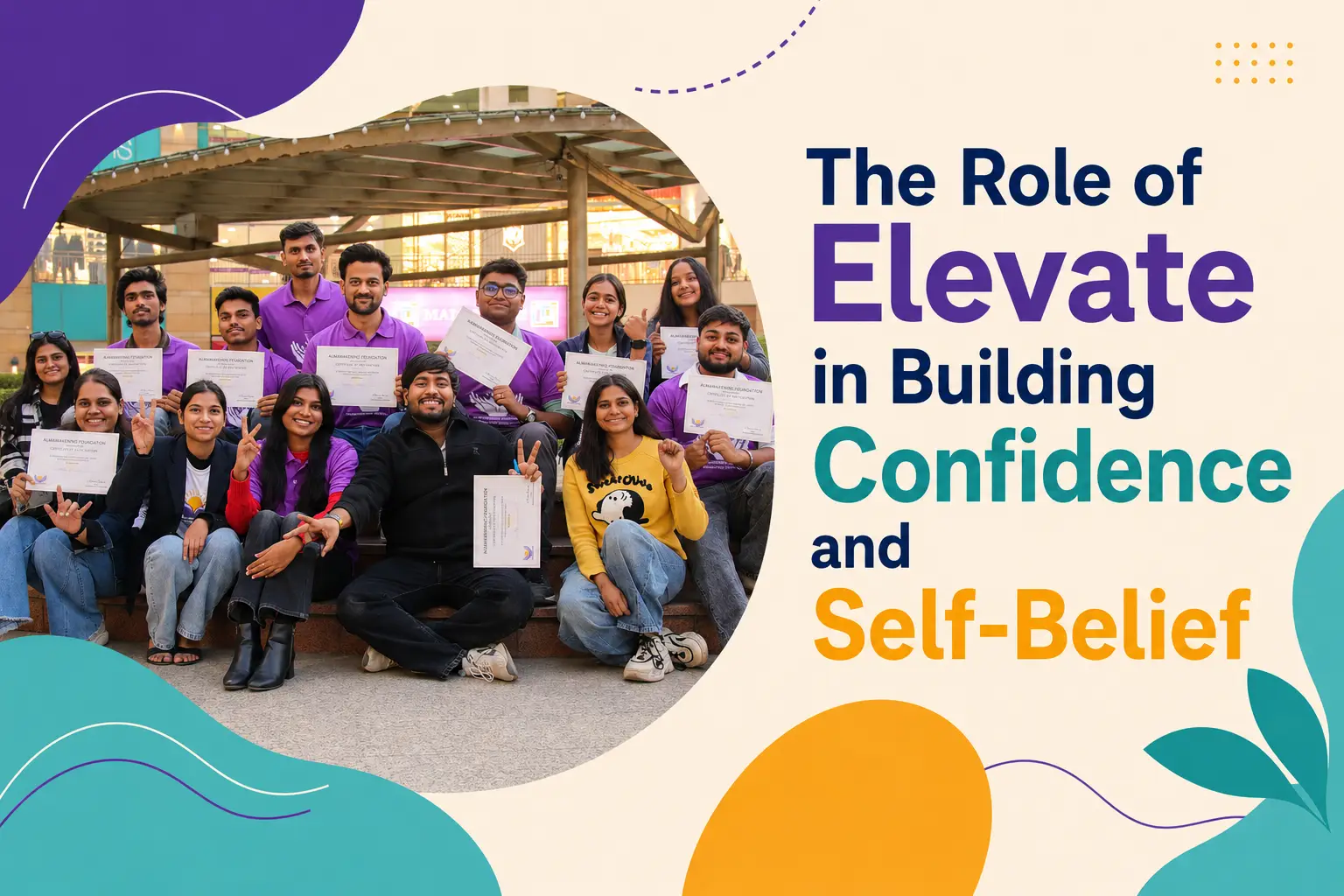
What happens when a person is told, year after year, that they do not quite belong? Not in so many words, perhaps. But through stares that are held for too long. Through buildings without ramps. Through job interviews that end the second a differently abled candidate steps in. The message settles in quietly until it hardens into a belief. And that belief is harder to break than any physical barrier ever raised.
That is what Elevate was designed to confront. Not with sympathy or surface-level awareness. But by going straight to the root: rebuilding self-belief from the inside out. We at Almawakening Foundation, recognised as one of the best NGOs in India, present ‘Elevate‘, a shift in how differently abled individuals see themselves, speak about themselves, and present themselves to the world.
Understanding Confidence and Self-Belief
Confidence and self-belief are not the same thing. Confidence can be borrowed. A polished outfit, a rehearsed pitch. But self-belief runs deeper. It is the quiet conviction that you belong, that your abilities hold weight, and that your voice deserves to be heard.
So why is self-belief important? Because without it, every opportunity feels like a stretch. Every public space feels like it was not built for you. And for differently abled individuals in India, it literally was not. Elevate does not simply tell people to “believe in themselves”. It shapes conditions where self-belief becomes the natural outcome through skills training, mentorship, peer communities, and real-world exposure.
The Importance of Representation and Inclusion
Differently abled individuals are still largely missing from India’s mainstream narratives. Absent from boardrooms, billboards, and classrooms. When they do appear, it is almost always through a lens of pity. When a young person living with a mobility condition never sees someone like them in a position of leadership, the unspoken message is brutal: this space is not for you.
We at Almawakening Foundation challenge this head-on. Our initiatives, including India’s first Differently Abled Awareness Walk at the India Fashion Runway, placed differently abled individuals on centre stage alongside designers, influencers, and changemakers. That is what building confidence looks like in practice. Not motivational posters. Visibility.
How Elevate Builds Confidence and Self-Belief
Elevate works because empowerment is not a single moment. The approach is layered, intentional, and deeply personal:
Skills-first approach
Confidence built on real capability lasts. Elevate prioritises vocational training, digital literacy, and career readiness so that differently abled individuals enter workplaces as contributors, never as concessions.
Mentorship with lived experience
Many mentors at Elevate are differently abled individuals who have moved through the same barriers. That mirror effect rewrites the story from “I cannot” to “they did, so maybe I can too.”
Community over isolation
Peer networks are built to share experiences, normalise challenges, and celebrate wins as one collective.
Public exposure
Participants take the stage at events, join panel discussions, and accept leadership roles. Confidence is shaped by doing, not by discussion.
Initiatives That Encourage Empowerment Through Elevate
Specificity is what pulls us away from generic inclusion drives. Every initiative holds a clear intent and an emotional core that connects:
EAEA (Empowering Abilities Enabling Access)
Back for a third season, these high-engagement events across Delhi and Gurgaon question what people assume and create direct encounters between differently abled individuals and mainstream communities.
Boldly Beyond Movement
Founded by Alma Chopra, who received a cerebellar ataxia diagnosis at age 10, this movement reframes strength through courage and self-belief. It connects because it stems from lived experience, not textbook empathy.
Accessibility Workshops
Past ramps and devices, these reshape outlooks. Communities, schools, and workplaces learn to identify bias and become active advocates.
| Traditional Inclusion Approach | Elevate’s Approach |
| One-time awareness sessions | Ongoing mentorship and skills training |
| Sympathy-driven messaging | Dignity-first, strengths-based framing |
| Differently abled as beneficiaries | Differently abled as leaders and contributors |
| Physical accessibility focuses only | Holistic: mental, emotional, social, and professional growth |
How Empowered Individuals Inspire Society
When a differently abled individual finds enough self-belief to walk into a job interview without apology, the ripple effect runs deep. Families shift. Parents who once kept children at home start pushing for accessibility. Employers question hiring criteria. Schools reconsider what an “ideal student” means.
At Almawakening, we reach across 10 states, and more than 15,000 individuals stand for thousands of quiet revolutions in homes, classrooms, and offices. That is what confidence multiplies into. It not only changes the person holding them. It changes everyone watching.
The Future of Confidence-Led Inclusion
More than 26 million differently abled individuals live in India. The majority are not seeking a cure. They are seeking a chance to learn, earn, lead, and belong. Inclusion will not be defined by policies alone but by how many lives receive the tools and the belief to claim their place.
Ready to drive this shift? Whether you are an individual, a corporate partner, or someone unwilling to accept the status quo, write to us today to schedule a consultation or request a custom collaboration plan.