
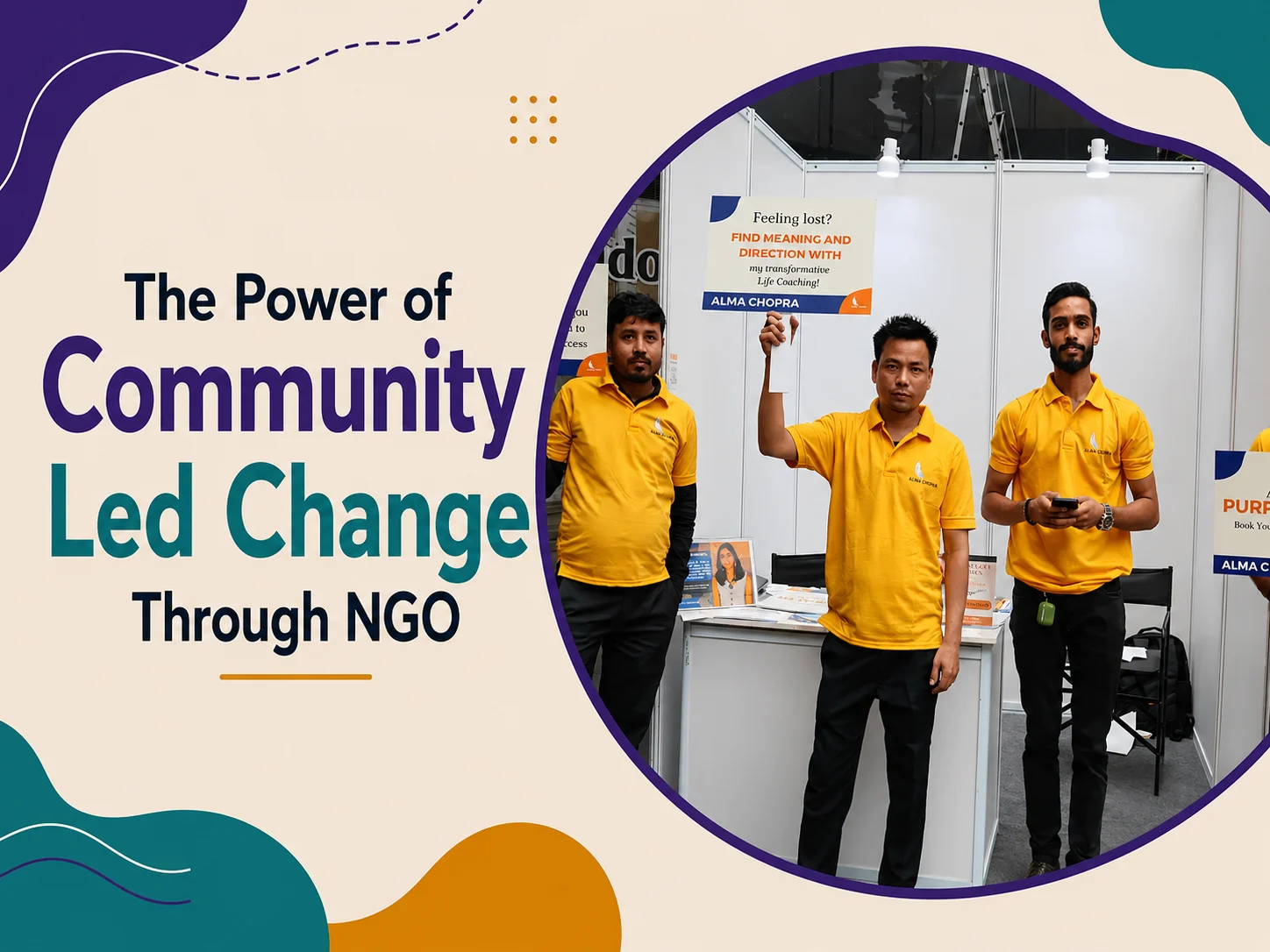
There is a particular kind of story that tends to stop people mid-scroll. It does not come from a government policy or a corporate initiative. It comes from a village, a neighborhood, or a small town where a group of ordinary people looked at the status quo, decided they had seen enough of it, and started doing something about it. That is what people-powered change actually looks like.
This is what drives community-led change. Across India and the world, non-governmental organizations (NGOs) are at the heart of fueling it. Not by arriving with predetermined solutions, but by standing alongside communities and helping them build something lasting. From empowering differently abled individuals to cultivating inclusive spaces for women, children, and marginalized groups, NGO-led initiatives are reshaping society from the ground up.
Community empowerment through NGOs is not a peripheral ideal. It is a force reshaping societies, lifting lives, and turning compassion into action.
The Growing Influence of NGOs in Community Development
For a long time, NGOs were viewed as gap-fillers, expected to step in wherever the government fell short. That perception has shifted dramatically. Now, they are recognized as strategic drivers of social change through community empowerment, policy reform, and grassroots development.
India alone has seen NGO projects for change touch millions of lives. Working in education, healthcare, women’s empowerment, and the inclusion of differently abled persons, these organizations understand that lasting impact is a product of trust, not funding.
At Almawakening Foundation, we make this shift tangible. Our work spans inclusion for differently abled individuals, women’s empowerment, education, and health — and to date, we have reached over 15,000 people across 10 states in India. That number matters to us, but it is honestly not what we lead with when we talk about what we do. Underneath it is a model of community engagement that gives our work its staying power.
Understanding the Core of Community-Led Change
What does community-led change actually look like when applied in practice?
The traditional development model has largely worked in one direction — outsiders come in, assess the situation, and build programs around what they think communities need. What we are talking about here is the opposite of that. Communities name the problems, communities shape the responses, and communities hold the outcomes. NGOs fit into that picture as support, not authority.
This approach holds particular power for differently abled individuals. People with physical or intellectual differences have historically been cast as passive recipients of aid, sidelined from decisions that affect them most. Community-led models challenge that narrative directly by placing differently abled persons at the center of decision-making. When a differently abled individual leads a local workshop, mentors peers, or advocates for accessibility in their own neighborhood, the impact reaches well beyond inclusion. It becomes a revolution.
At the core of NGO-led initiatives that prioritize community empowerment is a fundamental understanding: people do not need to be saved. They need tools, platforms, and the recognition that their voice matters.
Benefits of Community-Led Change Through NGOs
This model performs as well as it does because its foundation is built from the inside out. Below are some of the most significant benefits:
Sustainable Impact
Sustainable results follow community ownership of the change process. Programs developed with local input are not only more culturally relevant but also more capable of enduring well after external funding has ended.
Empowerment of Differently Abled
When NGO programs are truly inclusive, they do more than open doors; they build agency. Differently abled persons develop vocational skills, step into leadership roles, and make meaningful contributions to their communities. That shift reframes the broader narrative from dependence to self-reliance.
Stronger Social Cohesion
Grassroots development bridges divides of gender, ability, age, and economic status. It is that process that generates the trust communities rely on to endure periods of crisis.
Better Resource Utilisation
No external consultant understands a community’s needs better than the community itself. When communities drive the agenda, resources reach precisely where they are needed, reducing waste and increasing transparency.
Amplified Voices of the Marginalised
Our community frameworks treat differently-abled individuals, women, and youth as change-makers, not beneficiaries. Through volunteering, they step into that role fully and are given a real platform to be heard.
Our work at the Almawakening Foundation has shown us what this looks like in practice. Differently abled persons gaining ground through education, skill-building, and advocacy is not a small thing. It is the kind of change that holds because it grows from within the community, not from outside it.
Challenges and Solutions in Community-Led Change
It would be dishonest to overlook the obstacles involved. Community-led change brings with it real, persistent challenges that NGOs must approach and navigate thoughtfully:
Resistance to New Approaches
Across many regions, communities are conditioned to top-down interventions, which makes the transition to a participatory model a gradual process requiring patience, trust-building, and consistent engagement. Pilot projects that deliver tangible outcomes, however, serve as a proven starting point for bringing even the most skeptical stakeholders on board.
Funding Constraints
Grassroots development does not attract the donor attention it deserves. Sustaining long-term programs requires NGOs to spread their funding base across grants, CSR partnerships, crowdfunding, and volunteer networks.
Barriers Around Differently Abled
Societal attitudes toward differently abled individuals still represent a significant barrier, even as progress continues. Many communities default to a lens of limitation rather than potential when engaging with this population. NGOs push back through sustained awareness campaigns and by amplifying the achievements of differently abled leaders.
Measuring Impact
Community empowerment resists clean reduction to spreadsheet data. Increasingly, NGOs are integrating qualitative impact assessment methods with quantitative metrics to document the complete story of transformation.
Community involvement turns every challenge into an opportunity for a solution.
A Call for Collective Action in Community Development
Social change through NGOs is not a spectator sport — a truth that policy papers and funding reports often obscure. It requires collective action from individuals, businesses, institutions, and governments alike.
Volunteering for change is one of the most direct ways to contribute. From mentoring a differently abled young person to organizing an awareness drive or amplifying the voices of those working on the ground, every effort counts.
The Almawakening Foundation has taken a leading role in driving this effort forward. However, one truth remains constant: this is not work that can be done in isolation. Achieving a reality where inclusion is the norm, not the exception, calls for people who believe in community empowerment to take a visible and active stand.
Ready to be part of that change?
Get in touch today to schedule a consultation or request a custom quote and learn how you can make a real difference through the Almawakening Foundation and the broader movement of community-led change.