
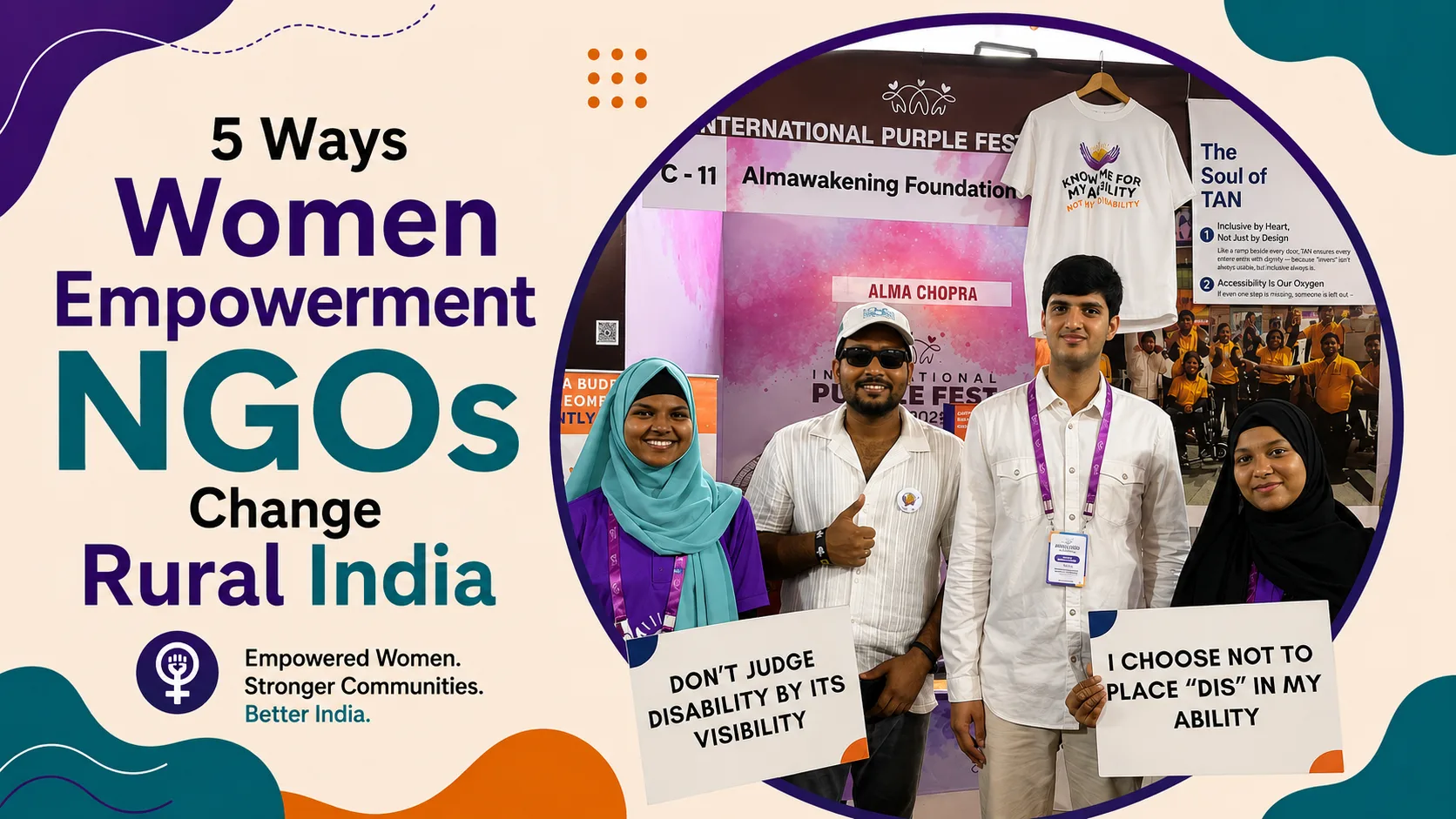
Picture rural India and you likely see open fields and unhurried villages. Behind that calm, millions of women are negotiating for things most people never have to ask for: an education, a doctor, and the right to decide how their own day goes. This is the gap women’s empowerment NGOs exist to close, not with handouts, but with tools that let women stand on their own.
At Almawakening Foundation, we watch the ripple effect play out constantly. One woman gains confidence, and her children eat better, her household grows healthier, and her village shifts a little.
The scale of the challenge is real. Rural women remain less likely than their urban counterparts to finish secondary school, and many are married before they turn eighteen. Those are not just statistics. They are opportunities lost across whole families.
| A handout approach | What lasting support looks like | |
|---|---|---|
| Timeframe | Meets today’s need | Builds tomorrow’s capability |
| Who decides | The giver | The woman herself |
| Outcome | Relief, then repetition | Independence that compounds |
| Measure of success | Amount distributed | Lives changed permanently |
1. Education and Skills: The First Domino
When a girl in a village learns to read, she does not simply gain a skill. She gains the standing to question, to decide, and to expect more.
Women’s empowerment NGOs run bridge courses, informal schools, and adult literacy programmes for women who never had the chance to sit in a classroom. But literacy alone does not pay for medicine. Vocational training turns knowledge into income, whether that is tailoring, computer basics, or running a small business.
Adult learners thrive when lessons are practical and immediately usable, which is why learning by doing beats rote memorisation. Women who complete these courses often report something beyond the earnings: a sense of identity that exists outside the household.
2. Health: You Cannot Empower Someone Who Is Exhausted
Health underpins everything else. A woman managing untreated illness has little left for education or enterprise.
The numbers are stark. According to NFHS-5 data released by the Government of India, 57 per cent of women aged 15 to 49 are anaemic. Fatigue, complications in pregnancy, and reduced capacity to work all follow from that single figure. Practical interventions matter: iron supplementation and teaching families to cook with leafy greens and lentils rather than around them.
Mental health deserves the same attention and rarely receives it. Training local health workers to recognise the signs changes that quietly.
Through ENABLE, we create access, safety, and dignity in public spaces, including assistive technology placed directly into people’s hands. Differently abled women face these barriers twice over, once for their gender and once for the assumptions made about their capability.
3. Economic Independence: Skills Into Livelihoods
Training is half the work. The other half is turning it into earnings.
Self-help groups remain one of the most effective mechanisms in rural India, an approach scaled nationally through the Deendayal Antyodaya Yojana. Ten women each save a small amount weekly, lend to one member for a sewing machine or a vegetable stall, and gradually build the credit history that opens a bank’s door.
Digital literacy multiplies this. With a smartphone and basic internet skills, a woman can sell directly or access government schemes without a middleman taking his cut. When a woman earns, the money moves through her family first. That is how cycles break.
4. Safety and Legal Awareness: Rights You Can Actually Use
Many rural women do not know their rights, and fewer know how to claim them.
Effective workshops start with the practical: what a First Information Report is, how to reach a protection officer, and which helplines exist, including the national women’s helpline on 181. Organisations also help women obtain Aadhaar cards and open bank accounts, because without documentation, welfare entitlements stay theoretical.
Some of the strongest results come from training local women as paralegals who guide their neighbours through the system. When one woman secures a protection order, the whole village learns the law is enforceable.
5. Community Engagement: Nobody Changes Alone
Empowerment is not a women’s issue to be solved by women alone. It requires everyone.
The most effective women’s empowerment NGOs bring men and boys into the conversation and enlist panchayat members and religious leaders as allies. When those figures publicly back a girl’s schooling, resistance drops sharply.
Through ENGAGE, we foster social inclusion and belonging through cultural and community programmes, while ENVOLVE brings communities, partners, and volunteers together to share responsibility for inclusive environments. Through ELEVATE, we bring inclusive stories and voices into spaces that shape perception, and through EXPAND, we improve infrastructure and develop accessible ecosystems that support inclusive growth.
When a village sees a woman running a business or chairing a meeting, leadership stops looking unusual.
Why the Five Work Together
These approaches are not separate tracks. An educated woman is healthier. A healthy woman earns. A woman who earns knows her rights are worth defending. A woman of standing is heard when she speaks.
That interdependence is what makes women’s empowerment NGOs effective. They address the whole person rather than one symptom. Our own initiatives have reached over 15,000 people across 10 states, and the pattern holds everywhere we work.
If you believe rural women deserve the same options as everyone else, there is a place for you in this.
Stand with us. Volunteer, partner, or support our work today, and help make sure that where a woman is born stops deciding what she can become.