
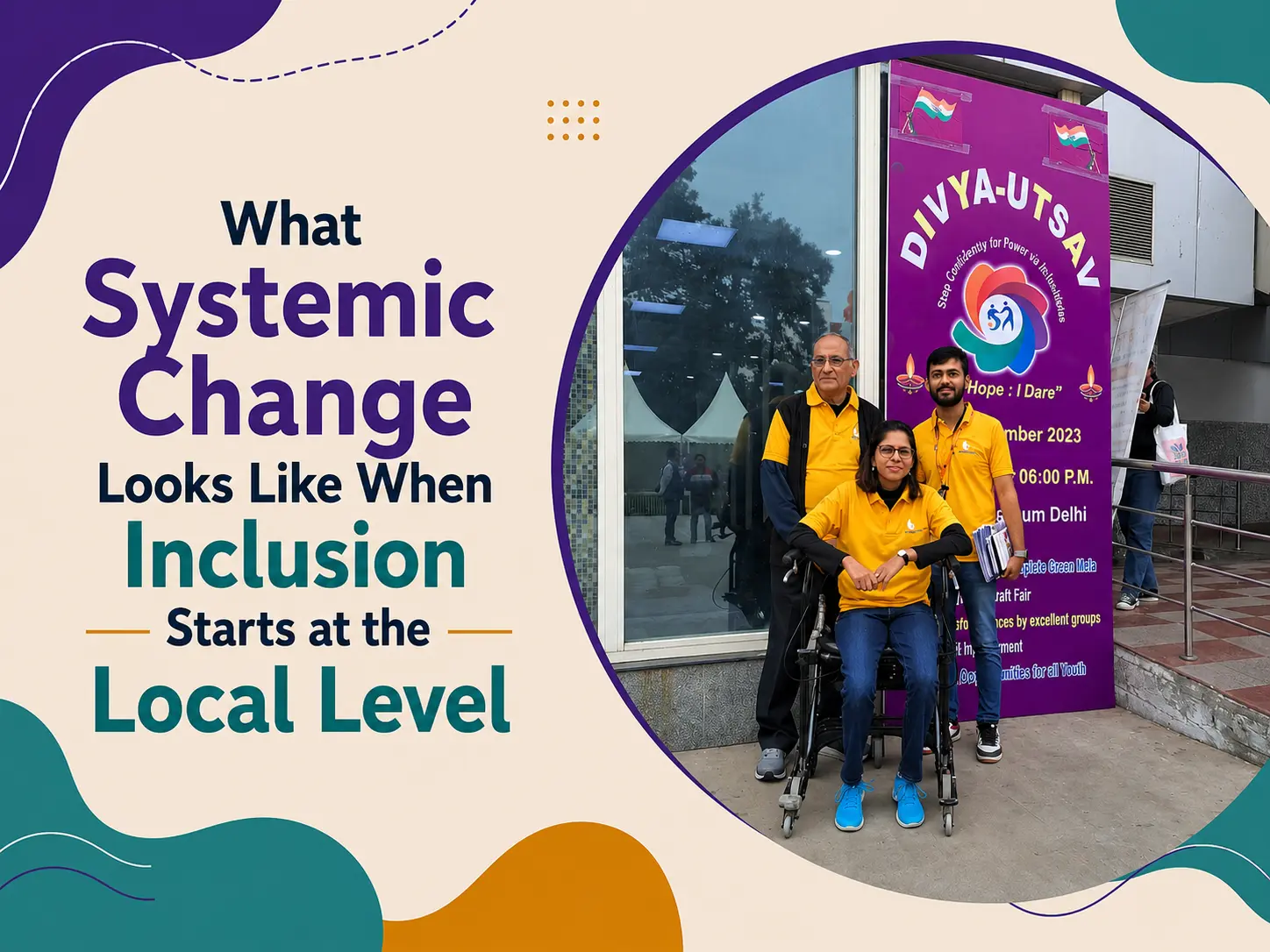
Inclusion does not fail from a lack of caring. It breaks down because it begins in the wrong place. Sweeping government policies. International frameworks. Polished reports loaded with big promises. Yet the person in a wheelchair still can’t get across the street in their own neighbourhood. The differently abled child still sits out at school. That’s the gap no one’s closing.
Real systemic change does not trickle down. It builds up. It starts locally, in the communities where differently abled individuals actually live, work, and show up every day. That’s exactly where NGO inclusion programs matter most, where community-driven inclusion moves beyond a line in a brochure and turns into something people can genuinely feel.
Why Top-Down Inclusion Keeps Falling Short
When it comes to policies for differently abled people, the world isn’t short on effort. Conventions have been signed, laws passed, and schemes proudly announced. And yet, this is precisely where things begin to crumble. Without proximity, policy is nothing more than paperwork.
A national mandate for accessible infrastructure sounds promising until you notice the local bus stop still does not have a ramp. Equal employment laws look great on paper, but they don’t teach a hiring manager how to interview someone with cerebral palsy. It’s in this gap between policy and practice that differently abled individuals continue to fall through the cracks.
That’s exactly why NGOs driving social change at the grassroots level are so critical. They work inside the gap. They see what policymakers miss, because they’re living in the same broken systems as the communities they serve.
What Grassroots Inclusion Actually Looks Like
Let’s get specific. Because “inclusion” is one of those words everyone loves until you ask them what it actually looks like on a random day in a mid-sized Indian city.
At its core, social inclusion at the grassroots means differently abled people are not just invited to participate. They are expected to. It means:
- An employer who looks at a differently abled candidate and sees talent worth investing in, not a charitable gesture.
- A school willing to reshape its classrooms instead of pointing students toward the door of a “special” institution.
- A community event built with accessibility at its core, not patched in as a last-minute fix.
- Awareness campaigns created and led by differently abled individuals, not just made for them.
When change comes from the community level, it reaches far beyond a single person. It shifts culture. It redefines how an entire locality understands ability and who deserves a place in it.
The Role of NGOs in Building Local Inclusion Ecosystems
That is exactly why we exist. At Almawakening Foundation, we’re not sitting around waiting for the system to catch up. We are out here building what should already be in place, from the ground up.
We work with differently abled individuals across India, weaving together education, employment support, employer advocacy, accessibility initiatives, and family counselling into a single, unified approach. Because inclusion was never just about helping someone build a skill. It is about ensuring there’s a job on the other end, a manager who actually understands, and a family prepared to let them fly.
Our local inclusion programs go beyond serving communities. They reshape them from the inside out, uniting business owners, educators, healthcare workers, and families around a single goal: ensuring no one gets left behind.
Why Differently Abled Communities Need More Than Sympathy
Society has a habit of framing differently abled people through one of two lenses: pity or inspiration. The truth is, neither actually serves them.
A differently abled individual is not a “brave soul” for walking out their door. They are not “defying odds” by putting in a job application. They are human beings finding their way through a world that was never designed to include them. What they need are systems built around their reality, not praise for enduring the failures of those systems.
This is why NGO inclusion programs that truly centre differently abled voices carry so much weight. When programs grow with the community rather than being handed down to it, dependency fades. The agency takes its place. You are building leaders, not recipients.
Five Markers of Real Systemic Change at the Local Level
What does it actually look like when inclusion works in a community? These five signs show that community-driven inclusion has moved past good intentions and into real action:
- Differently abled individuals lead. They sit on school boards, serve in local governance, and shape community planning. These aren’t token advisory roles. They carry actual decision-making power.
- Local businesses hire differently-abled employees because they want what diverse thinking brings to the table, not because there’s a quota to fill.
- Public spaces are accessible from day one. Not retrofitted after complaints. Not listed as “coming soon.” Built right the first time.
- Families of differently abled members are supported, not stretched thin. Counselling, resources, and strong networks are in place, all working toward one thing: independence.
- The language shifts, too. “They should be grateful” gets replaced by “They deserve better.” That’s not a policy change. That’s a culture rewriting itself from the ground up.
What Happens When Communities Lead the Way
When NGOs driving social change invest at the local level, the impact multiplies in remarkable ways. A single trained employee leads to five inclusive jobs. A single accessible school rewrites the expectations of an entire generation. A single family that learns to ease up on overprotection ends up raising a young adult who gives back to the economy and culture in ways no one could have predicted.
The real power of community-driven change is how it builds on itself. It doesn’t need a national campaign to make a difference. It just needs people who refuse to sit around and wait for someone else to act.
At Almawakening Foundation, we put this belief into practice every single day. Our model connects education, skills training, employer partnerships, and family support into one cohesive framework. The goal? Building infrastructure that doesn’t just invite differently abled individuals to participate but makes that participation practical, meaningful, and permanent.
The Takeaway
Systemic change is never just a policy announcement. It’s a fundamental shift in how communities work, who they welcome, and what they’re willing to call “normal.” For differently abled individuals, that shift doesn’t start in some parliament building. It starts much closer to home: at the street corner, the school gate, the hiring desk.
If you want to be part of building a community where differently abled people don’t simply survive but truly thrive, the time to act is right now.