
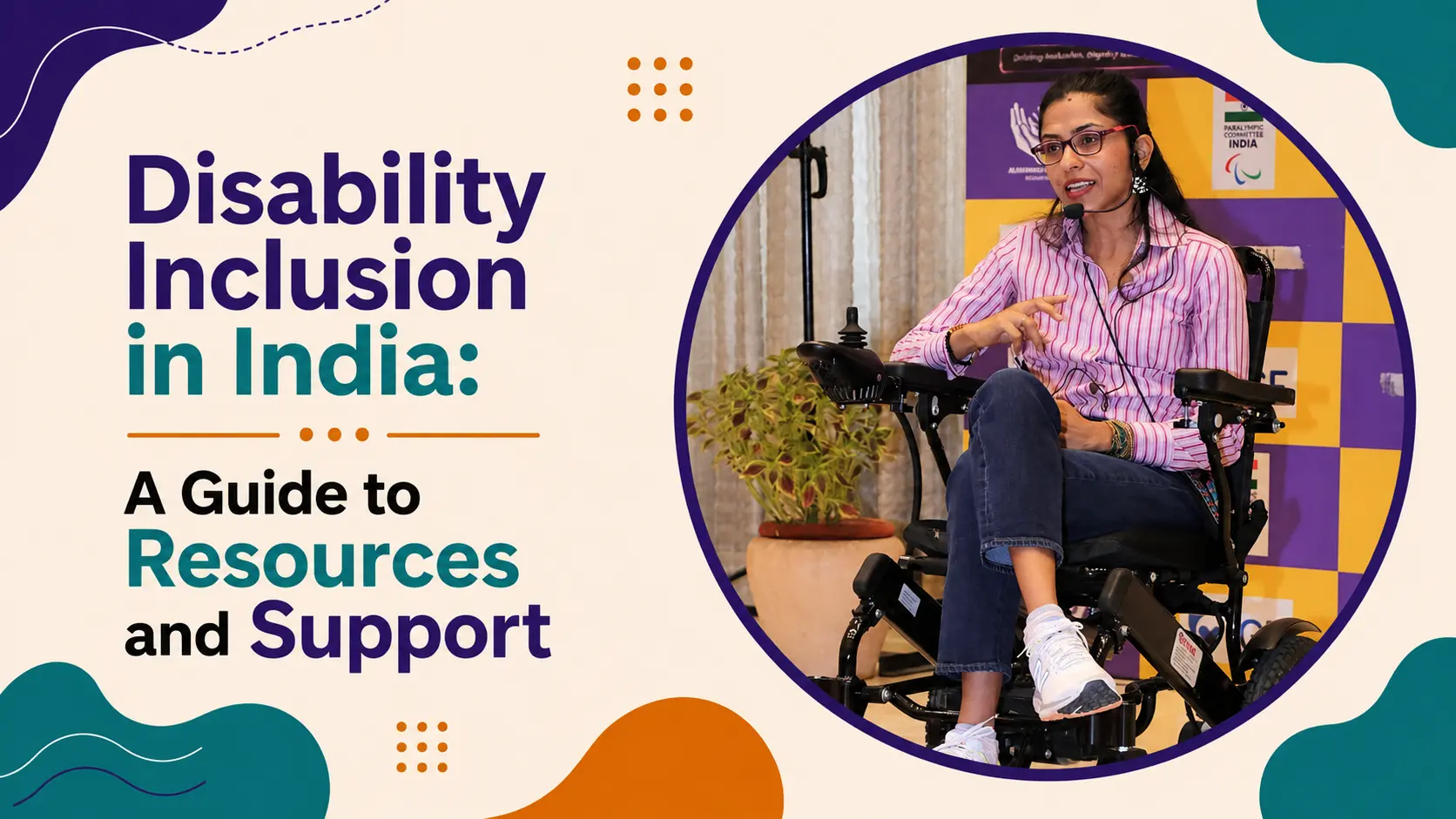
Search for inclusive support services in India, and you will fall down a rabbit hole of dense legal documents, outdated directories, and promises that never turn into anything. It is exhausting, and it is the reason so many people give up before they find what they need.
At Almawakening Foundation, we take a different view of what inclusion means. It is not a paper exercise. It is a world where ramps lead to real classrooms, sign language opens real conversations, and a student with low vision can walk into a library and find a book they can actually read. This guide maps seven resources that already work, most of which you can use without us.
Why a Law Alone Was Never Going to Be Enough
India’s Census 2011 counted 26.8 million differently abled citizens, and most researchers accept the true figure is considerably higher. The turning point came with the RPWD Act 2016, which replaced a law from 1995 and expanded recognition from seven conditions to twenty-one. Inclusion became a right rather than a favour.
But rights on paper and access in practice are two different things. People still face inaccessible transport, biased hiring, and schools that quietly turn them away. That gap is where inclusive support services in India actually matter.
| Inclusion on paper | Inclusion in practice | |
|---|---|---|
| Access | A ramp at the back entrance | Step-free from the front door |
| Education | Admission granted | Accessible materials and trained teachers |
| Employment | A quota exists | The post is actually filled |
| Community | Awareness campaign | Everyday belonging |
1. The RPWD Act 2016: Know Your Rights, Then Use Them
The Act hands you a genuine toolbox. Reservation in government employment, inclusive education mandates, accessibility standards for public buildings, and a pension provision. Yet most people have never read a word of it, and honestly, who could blame them?
It rests on five principles worth remembering: non-discrimination, equality of opportunity, accessibility, reasonable accommodation, and affirmative action. Knowing your rights is what turns you from a passive recipient into someone who can ask, and expect, better.
2. The UDID Card: One Card Instead of a Folder
This is the resource most guides skip, and it is arguably the most useful. The Unique ID serves as proof of eligibility everywhere, replacing the folder of certificates people carry from office to office. It unlocks the pension, subsidised assistive devices, and scholarships alike.
You apply online at swavlambancard.gov.in using Aadhaar e-KYC, and you can track the application on the same portal. One card, proof for life.
3. State Commissioners and Grievance Channels
Every state has a Commissioner for Persons with Disabilities, and this office exists precisely for the moment a right on paper fails to arrive in practice. Complaints about inaccessible buildings, denied admissions or ignored reservations can be filed there. Use them. Offices that receive no complaints are assumed, wrongly, to be serving everyone well.
4. Assistive Technology and Device Schemes
Subsidised aids exist for far more than most people realise. Mobility equipment, hearing aids, screen readers, low-vision devices and communication tools are all available through government schemes once you are certified.
The barrier is rarely eligibility. It is knowing what exists. If you take one action after reading this, make it a conversation with your district welfare office about what your certification already qualifies you for.
5. Accessible Education and Digital Skills
For a child with low vision, the barrier is rarely the textbook. It is the absence of a braille version. For a wheelchair user, it is the flight of stairs at the school gate.
Inclusive education needs trained teachers, accessible curriculum and assistive technology working together. Digital literacy matters enormously too, because in an economy moving online, anyone who cannot navigate a screen gets left behind by default. Screen readers and voice-controlled tools are not luxuries. They are the difference between a classroom that admits you and one that prepares you.
6. Community Networks and Peer Support
The most underrated resource in this list costs nothing. Parent groups, peer networks, and local collectives carry practical knowledge that no portal contains: which hospital board moves quickly, which school actually delivers on its admissions promise, and which employer follows through.
Among all inclusive support services in India, this is the one people find last and value most.
7. What We Add Through Our Five Pillars
Where the above leaves gaps, our work sits.
Through ENABLE, we create access, safety and dignity in public spaces. In collaboration with Dr Shroff’s Charity Eye Hospital, 26 beneficiaries with visual impairment received AI-enabled smart vision glasses supporting mobility, reading, object recognition and navigation. As our founder, Dr Alma Chopra, put it, the programme exists to build accessibility, inclusion and innovation. Tools, not gestures.
Through ENGAGE and ENVOLVE, we build belonging, because physical access opens a door, but belonging is what makes someone stay. Our Empowering Abilities Enabling Access series drew more than 300 attendees across Nexus Select CityWalk in New Delhi and MGF Metropolis in Gurgaon.
Through ELEVATE, we bring inclusive stories into spaces that shape perception, because you cannot become what you have never seen. And through EXPAND, we improve infrastructure and accessible ecosystems. That is the slowest and least photogenic work we do and the kind that outlasts everything else. A ramp stands. An accessible portal stands. A one-day event does not.
Where You Come In
Inclusion is not a spectator sport.
- Raise accessibility gaps where you live and work
- Support businesses and organisations that get it right
- Volunteer with us on the ground
- Help this reach the family who needs it
The resources on this list already exist. The work now is making sure fewer people spend months looking for them. Whether you need inclusive support services in India for yourself, your family, or your workplace, the route is shorter than the search results suggest.
Stand with us. Volunteer, partner, or support our work today, and help build an India where inclusion is simply how things are done.