
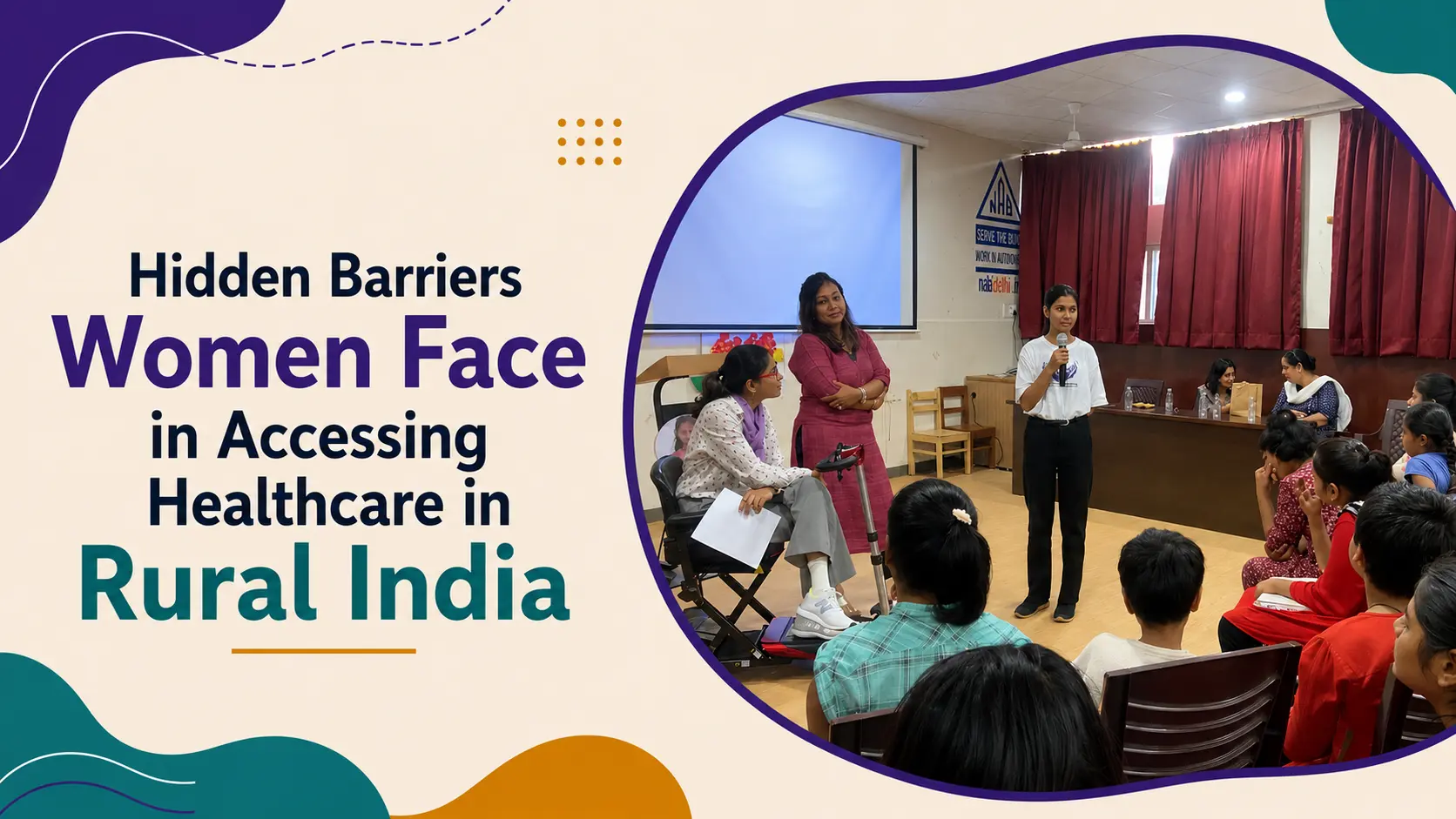
Have you ever thought what happens when a woman in a remote Indian village falls sick?
In many rural parts of India, healthcare is technically “available”. Clinics exist, government programmes are announced, and awareness campaigns run throughout the year. Yet for millions of women living in villages, accessing that care remains surprisingly difficult. Most of these barriers are not the kind you can see. There are many boundaries, such as social expectations, economic limitations, cultural beliefs, and systemic gaps — they all work quietly to keep women from the care they deserve. And for many women, the healthcare journey turns overwhelming long before a clinic visit is even on the table, because mobility difficulties and deep-rooted social stigma stand in the way.
Understanding these realities is essential to building a healthcare system that works for everyone. The real barriers to healthcare for women in rural India make one thing clear: improving rural healthcare access demands far more than the construction of additional hospitals. In this blog, we will discover the hidden barriers and what it truly takes to make rural healthcare accessible.
The State of Women’s Healthcare in Rural India
India’s rural population accounts for nearly 65% of the country, but the healthcare resources reaching these areas tell a different story. Doctor-to-patient ratios stay well below the WHO-recommended 1:1000 standard, and in states like Chhattisgarh, primary health centres report doctor vacancy rates of up to 71%. Women pay the price first.
The National Family Health Survey (NFHS-5) puts this gap in numbers: 64% of women with no formal education cited facility-level barriers, compared to 42% among women with higher education levels.
One reality that rarely enters policy discussions is the entirely separate layer of exclusion faced by differently abled women in rural India. Most rural health centres are without ramps, accessible toilets, or staff equipped to support women with physical, sensory, or cognitive challenges. For a differently abled woman in a village with no paved road connecting her to the nearest clinic, the healthcare system offers little more than the appearance of access.
Understanding the Key Barriers to Healthcare Access
For women in rural India, barriers to healthcare rarely stand alone. They pile upon each other, constructing a wall that is nearly impossible to scale without help.
Geographic Isolation
Many villages are positioned 30 to 50 kilometres from the nearest health centre, where roads are unpaved, ambulances are scarce, and public transport offers little dependability. For differently abled women who depend on wheelchairs or mobility aids, covering that distance becomes a near-insurmountable barrier.
Financial Barriers
Out-of-pocket spending constitutes roughly 47% of India’s total health expenditure. In Odisha, nearly 40% of hospitalised families are forced to borrow or sell assets to manage costs. Women who lack independent income face the sharpest end of this crisis. For differently abled women, sustained rehabilitation costs only add to that pressure.
Socio-Cultural Gatekeeping
Getting medical care, for many women, starts with getting permission from a husband or in-law. That is the reality across numerous communities. Menstrual health, reproductive issues, and mental well-being. These are still subjects people avoid discussing openly. For differently abled women, the situation is worse. Both families and healthcare providers are quick to label their health concerns as untreatable or not worth addressing.
Shortage of Female Providers
In rural communities, cultural norms prevent women from consulting male physicians. The severe scarcity of female doctors in these areas means women frequently postpone or avoid care entirely, especially for maternal, gynaecological, and mental health concerns.
Digital and Information Gaps
The digital divide hits rural women hardest. They are 15% less likely to own a mobile phone and 33% less likely to use the internet than men, cutting off access to telemedicine, health information, and scheme registrations. For differently abled women with visual or hearing challenges, the absence of assistive technologies makes these barriers even more pronounced.
Caste, Religion, and Intersecting Discrimination
Women from SC and ST communities face compounded barriers at every level. For Dalit and Adivasi women, outright refusal of care is a documented reality. When a physical or cognitive condition intersects with these marginalised identities, the exclusion grows significantly deeper.
Government Initiatives and Programs to Improve Access
India has put in place several schemes to reduce the rural healthcare gap for women:
- National Health Mission (NHM): NHM established ASHA workers, over nine lakh community health activists who act as the first point of contact between rural families and the public health system, steering mothers through antenatal care, immunisation, and institutional delivery.
- Janani Suraksha Yojana (JSY): A cash transfer scheme directed at pregnant women below the poverty line. Since its introduction, the rate of institutional deliveries across India has grown from 39% to 79%.
- Janani Shishu Suraksha Karyakram (JSSK): Ensures pregnant women and sick newborns at government facilities receive free delivery, medicines, diagnostics, transport, and meals.
- Ayushman Bharat (PM-JAY): Extends an annual hospitalisation benefit of ₹5 lakh per family, targeting the bottom 40% of the population.
While these schemes have delivered results, persistent challenges continue to undermine progress. Among the most marginalised, awareness remains critically inadequate. Differently abled women are largely absent from program design considerations. Physical accessibility at health centres and inclusive outreach materials are rarely given the attention they require.
How Almawakening Supports Rural Women’s Access to Healthcare
The Almawakening Foundation was never about awareness alone. The real work is in removing the barriers, most of them invisible, that shut rural women and differently abled women out of healthcare entirely.
Four pillars guide that work: inclusion for the differently abled, women’s empowerment, education and skills training, and health and well-being. None of these stands alone. Healthcare access is tied directly to literacy, economic independence, social acceptance, and community support. Address one and ignore the rest, and the gap stays open.
On the ground, our work reaches women where they are, spanning health awareness camps that actively include differently abled participants, advocacy for accessible clinic infrastructure, and support networks that empower women to seek care without shame or permission.
Moving Toward Inclusive Healthcare for Rural Women
Improving rural healthcare access for women cannot be solved through a single policy. It requires a fundamental shift in how health equity is approached at every level.
That shift must treat differently abled women as a visible priority, not an afterthought. This means accessible clinics, inclusive health worker training, and awareness materials produced in large print, audio, and regional sign language. It also means directing funding toward organisations like Almawakening, which do the hard, community-level work of closing these gaps.
Every woman deserves equality regardless of her economic status, state of living, or place of living.
Ready to be part of work that truly matters? Contact us today to explore how you can volunteer, donate, or partner with Almawakening Foundation as we build inclusive, accessible healthcare for rural women across India.