The biggest misconception about differently abled individuals isn’t that they cannot work. It’s that they need to be “given a chance.” They don’t. They need the barriers taken out of their way. The talent is already there. So is the drive. What’s actually missing is a world that stops building workplaces, hiring processes, and career paths around one type of body and one type of mind.
India is home to roughly 30 million differently-abled citizens. Around 13 million are employable. Just 3.4 million have managed to find work. Let that sink in. This is not a question of talent. It’s a structure built to exclude, wearing the mask of one who simply didn’t think to include. And until we are willing to name it for what it is, employment for dignity will remain a phrase that lives in policy papers and dies before it ever reaches the people it was meant to serve.
What a Job Actually Means When the World Has Written You Off
A job, for most people, is simply routine. Show up, put in the hours, and get paid. But ask someone with a disability who’s faced rejection after rejection, who’s walked out of interviews knowing they were dismissed before they even spoke, and you will hear a different story. For them, landing a role is not just employment. It’s proof that capability was always there. It was the system that fell short.
Work as empowerment, for differently abled people, goes well beyond the salary slip:
- Financial autonomy that finally breaks the cycle of relying on family or welfare systems. When a 28-year-old with cerebral palsy starts managing their own bank account, that’s not a minor milestone. That’s a revolution happening inside one home.
- Routine and purpose that directly counter the mental health impact of prolonged unemployment and isolation. These are realities that hit differently abled individuals at rates most of us don’t fully grasp.
- A social identity that isn’t defined by their condition. When a colleague casually introduces them as “our analyst” instead of leading with their differently abled status, something quietly shifts in the room.
- Real, visible proof for other differently abled individuals sitting on the sidelines, asking themselves whether it’s worth giving it a shot.
When workplaces actively choose inclusion, they set something in motion that no policy alone can create: a person’s real belief in their own worth. That’s dignity at work in its truest, most powerful form.
The Barriers Are Systemic, Not Personal
India’s Rights of Persons with Disabilities Act, 2016, mandates 4% reservation in government and private sector jobs for differently abled individuals. Sounds progressive, right? Now consider the Nifty 50, India’s largest corporations. Just five of them have more than 1% differently abled individuals on their rolls. Four of those five are public sector units. If top companies can’t manage even 1%, this isn’t a talent problem. It’s a willingness problem, built into the structure itself.
The real barriers are specific, and every one of them has a solution.
- Interview processes that exclude by default. Timed assessments, inaccessible application portals, and interview panels without sign language interpreters disqualify candidates before they’ve had a chance to prove anything.
- Workplaces are designed for a single body type. Narrow doorways, no ramps, fixed workstations, and inaccessible restrooms continue to be standard across Indian offices.
- A culture of pity, not partnership. Too many employers see hiring differently-abled individuals as charity work, not strategy. That mindset leads to token positions with dead-end trajectories and zero room to grow.
- Vocational training that stops too early. India runs 24 National Career Service Centres for the Differently Abled, but the connection between completing training and landing a job is still painfully weak.
In 2021, India’s Supreme Court made a pointed observation: simply prohibiting discrimination isn’t enough to guarantee people a life of dignity. Prohibition, after all, is passive. Inclusion demands something more. It demands action.
What Real Job Empowerment Looks Like on the Ground
Empowering differently abled individuals in the workplace was never about lowering the bar. It was always about rebuilding the floor so everyone has a fair shot at reaching it. Are the organisations doing this well? They follow a set of non-negotiable practices:
- Hiring is rethought for real access. Flexible assessments, alternative interview setups, and application platforms that recognize screen readers as baseline, not bonus.
- Mentorship is tied to actual career mapping. Not a buddy system that disappears after the first week, but long-term guidance helping differently abled employees chart a path to promotions.
- Assistive technology embedded as infrastructure. Speech-to-text, adaptive keyboards, and modified machinery are all covered as operational expenses from day one.
- Performance reviews need to focus on what someone actually produces, not what we assume they can do. A differently abled analyst who consistently delivers accurate forecasts deserves to be judged on those results, not on typing speed.
When companies genuinely invest in helping differently abled employees become self-reliant, they earn loyalty, build deeper empathy across teams, and end up attracting stronger candidates overall.
One Hire Changes More Than One Life
When a differently abled person in a middle-class Indian family brings home their first paycheck, everything shifts. The way the family talks about money changes overnight. Roles evolve from sheltering to standing shoulder-to-shoulder. And somewhere close by, a younger, differently abled child watches and quietly thinks: that could be me.
- Employment rooted in dignity sets off a ripple effect:
- Families move from managing a condition to backing a career. That’s a completely different conversation.
- Communities begin seeing differently abled individuals not as people who need help, but as professionals who bring value.
- Training centres walk away with something tangible: proof that investing in differently abled students leads to real outcomes.
And that’s precisely why work as empowerment is irreplaceable. No welfare program comes close to matching the psychological shift that happens when a person earns their own way.
What Almawakening Foundation Is Building
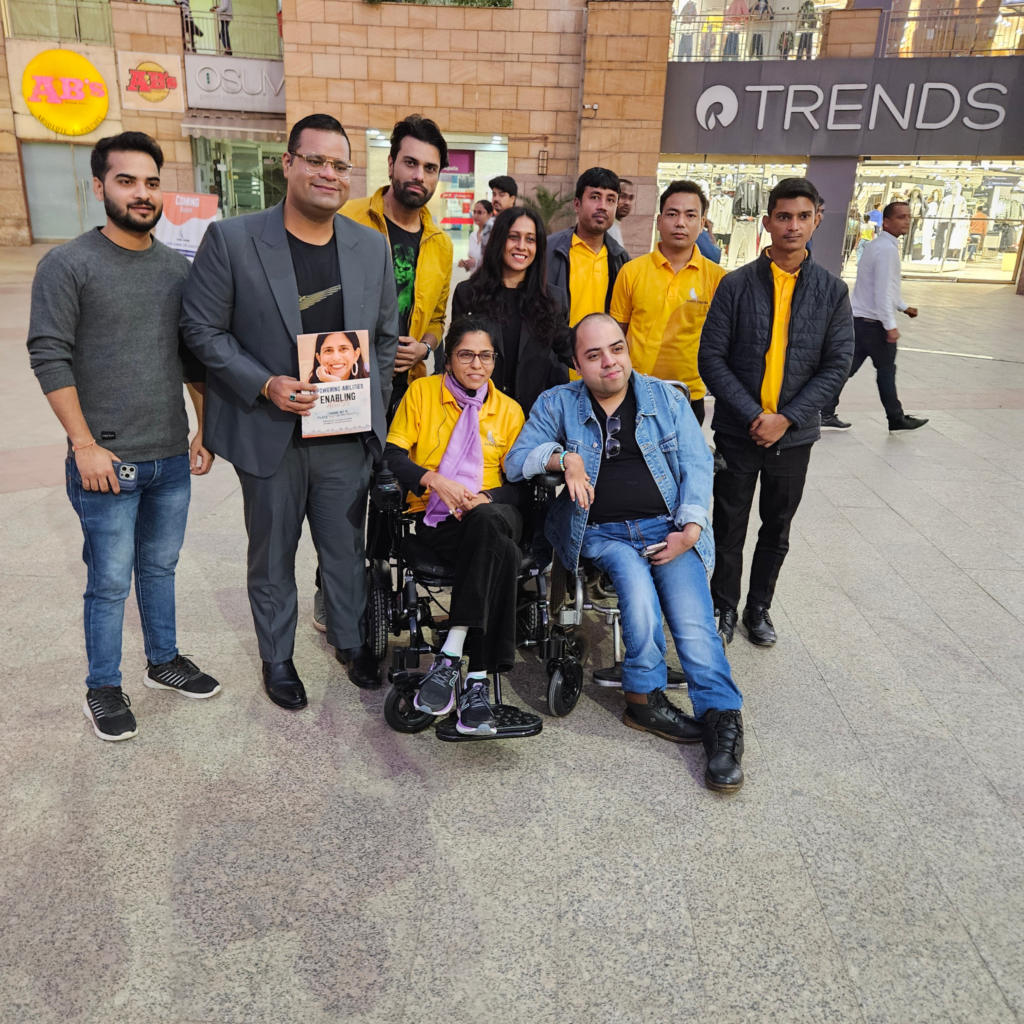
At Almawakening Foundation, inclusion is not a line item on an org chart. It’s the ground everything is built on. Through skills training, community advocacy, and hands-on engagement with differently abled individuals across India, the Foundation bridges the distance between what people are capable of and what the world actually lets them do.
Every program we build comes back to a single measure: does it bring someone closer to real self-reliance? Not dependence. Self-reliance that still holds on a Monday morning, when the alarm sounds and there’s somewhere worth showing up to.
The Path Forward Is Not Theoretical
Thirty million differently abled individuals. Thirteen million are prepared to contribute. The math isn’t complicated. The gap is in our response.
Employment is not generosity. It is a right being quietly denied. Every organisation that looks at capability first and conformity second is not ahead of the curve. It is catching up.
Ready to step in? Connect with us at Almawakening Foundation to learn about our inclusion programs and partner with our training efforts. Because dignity is not a gift. It is earned, supported, and shared.