
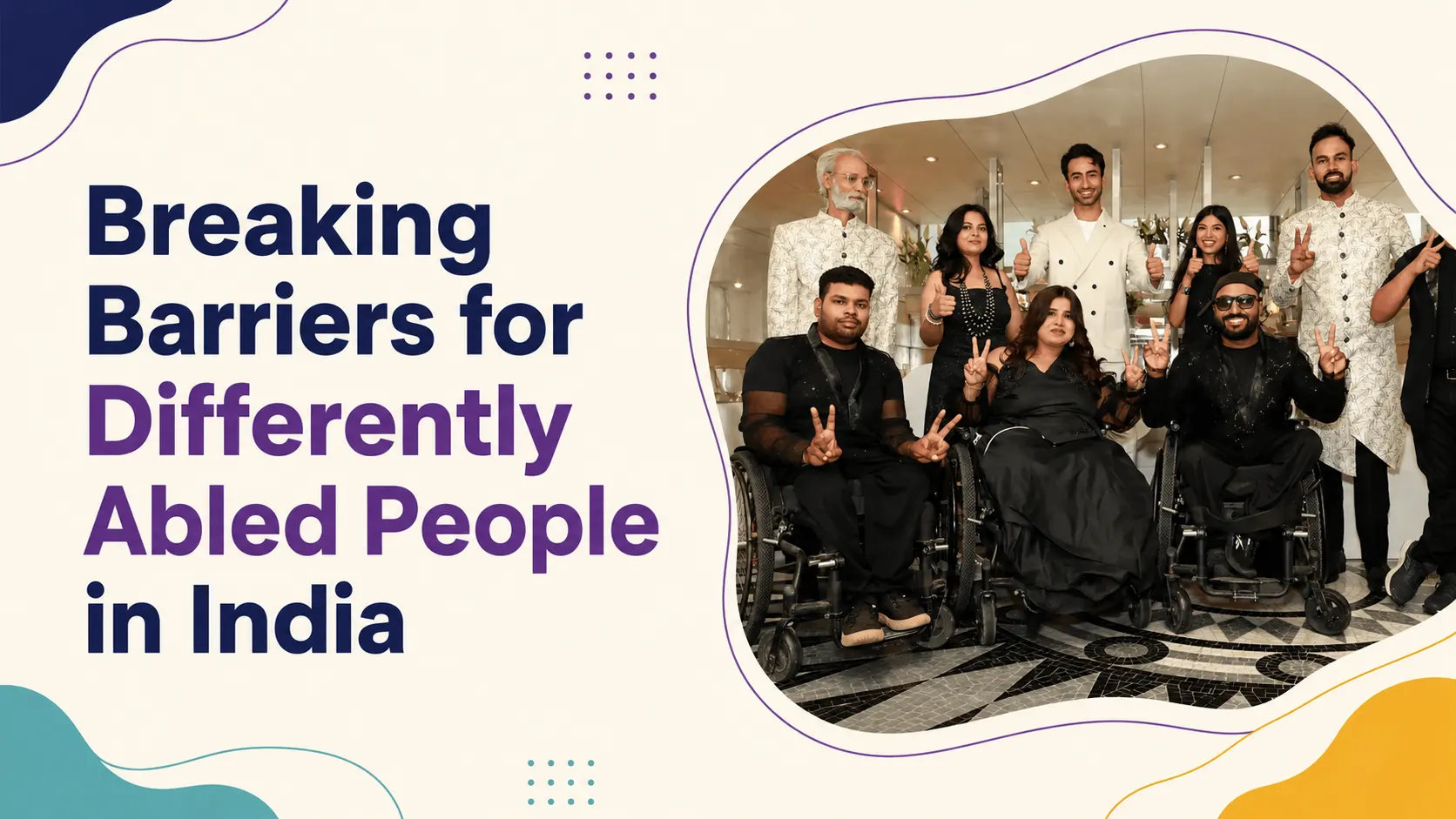
Understanding the Everyday Barriers Differently Abled People Face
You step outside, ready to start your day. But the ramp doesn’t exist. The bus can’t accommodate you. The doorway is too narrow. Now imagine that’s not a bad morning. That’s every morning. For more than 30 million differently-abled people in India, this is just how life works.
We talk endlessly about progress and celebrate every milestone. Yet here’s the uncomfortable part: the obstacles preventing differently abled individuals from living independently aren’t lurking in some dark corner. They’re everywhere. In classrooms. Workplaces. Public streets. And most frustratingly, in how we think about disability itself. Until we confront that reality, inclusion remains something we aspire to, not something we practice.
This blog unpacks the everyday challenges faced by differently abled people in India, not to highlight struggles alone but to spark the kind of awareness that leads to action.
Educational Barriers and the Need for Inclusive Learning
Education is supposed to be the great equaliser. Yet, for millions of differently abled children across India, schools remain inaccessible fortresses.
Nearly 27% of children with certain physical or cognitive conditions have never attended any educational institution. For those with intellectual conditions, that number climbs to a staggering 50%. These aren’t just numbers. The accessibility issues in India start from the ground up. Literally. Schools without ramps. Classrooms without assistive technology. Teachers without training in inclusive pedagogy.
But the barriers run deeper than infrastructure:
- Attitudinal roadblocks: Many educators operate under outdated assumptions about what differently abled students can achieve
- Curriculum gaps: Standard teaching materials rarely account for varied learning needs
- Social exclusion: Bullying and isolation push many students out of mainstream education
- Geographic challenges: Rural areas face severe shortages of specialised support services
When we fail to create inclusive learning environments, we don’t just limit individuals. We deprive society of diverse perspectives and untapped potential.
Barriers to Employment and Financial Independence
Here’s a number that deserves attention: India has approximately 13 million differently-abled individuals who are employable. But only 3.4 million of them are working. Nearly 10 million people remain cut off from earning their own living.
Look at workforce participation, and the disparity sharpens. Some 60% of non-differently abled adults participate in the workforce. Among differently abled individuals, it’s 36%. For women with physical or sensory conditions, participation falls to just 23%.
What’s holding employers back?
- Misconceptions about cost: Many businesses believe accommodating differently abled employees requires expensive overhauls
- Infrastructure excuses: Less than 25% of Indian workplaces offer accessible facilities
- Hiring bias: Recruiters often filter out candidates based on assumptions rather than abilities
- Limited talent pipelines: Without inclusive education, the qualified candidate pool remains small
India’s Rights of Persons with Disabilities Act 2016 mandates 4% job reservation. The reality? Among the country’s top 50 companies, just five employ more than 1% differently abled staff.
What these companies are missing is significant. Differently abled employees consistently demonstrate unique problem-solving skills, deep loyalty, and exceptional resilience. Lemon Tree Hotels has proven what’s possible when businesses commit to inclusive hiring: not a burden, but a thriving workforce.
The Role of NGOs in Breaking Barriers and Creating Change
Wherever government systems struggle to reach, community-driven organisations pick up the slack. NGOs throughout India are doing the hard work on the ground, raising awareness, building skills, and carving out real pathways to inclusion.
Their work makes a difference on multiple levels:
- Advocacy and policy influence: Pushing for stronger implementation of existing laws
- Skill development programs: Bridging the education-to-employment gap through vocational training
- Community sensitisation: Changing attitudes through workshops and direct engagement
- Support networks: Connecting differently abled individuals with resources and mentorship
- Research and documentation: Building evidence for informed policy decisions
Smart organisations know there’s no universal formula for inclusion. Supporting someone with mobility challenges looks completely different from supporting someone with a sensory condition. Getting this right means staying deeply connected to the communities you serve, not guessing from a distance.
NGOs are the connectors. They link differently abled people in India to opportunities that should never have been out of reach in the first place. They turn policy language into real-world change and celebrate the wins that prove what’s possible once obstacles are removed.
How Almawakening Works Toward Inclusion and Empowerment
At Almawakening Foundation, inclusion isn’t something we hope for. It’s something we owe. Every day, we work to build spaces where differently abled individuals don’t just participate—they flourish.
Through our initiatives, we tackle barriers at multiple levels:
- Awareness and attitude transformation: We conduct sensitisation drives across schools, workplaces, and communities because lasting change begins with how we think about ability.
- Education and skills training: Our programs equip differently abled individuals with practical skills that open doors to meaningful employment.
- Community building: We create spaces where families and differently abled individuals connect and support one another.
- Advocacy for accessible infrastructure: We work with institutions to push for barrier-free environments.
Across 10 states, we’ve connected with over 15,000 people. And while those numbers matter, they don’t tell the whole story. We’ve watched students chase degrees they once thought were out of reach. We’ve seen professionals build careers after being told no more times than they could count. We’ve stood with families in their hardest moments and watched hope take root.
Wrapping Up
The barriers facing differently abled people in India aren’t set in stone. They’ve been built by societies and systems that simply haven’t made inclusion a priority. And what’s been built can be rebuilt.
Every ramp constructed makes a difference. Every inclusive classroom transforms lives. Every employer who judges ability over assumption breaks a tired cycle. Every conversation that pushes back against stereotypes shifts the culture, one person at a time.
The truth is, individual efforts can only take us so far. Lasting change requires collective commitment, steady investment, and organisations prepared to do what it takes to make a real difference.
That’s where you come in.
Whether you’re an individual ready to make a difference, a business working to create a more inclusive workplace, or an organisation looking to partner for real change, Almawakening Foundation is here to walk that path with you. Because breaking down social barriers isn’t something a handful of people can do alone. It takes all of us.
Contact us today to discover how you can be part of this movement toward real inclusion. Together, we can build a world where ability is celebrated, and barriers fade into memory.