
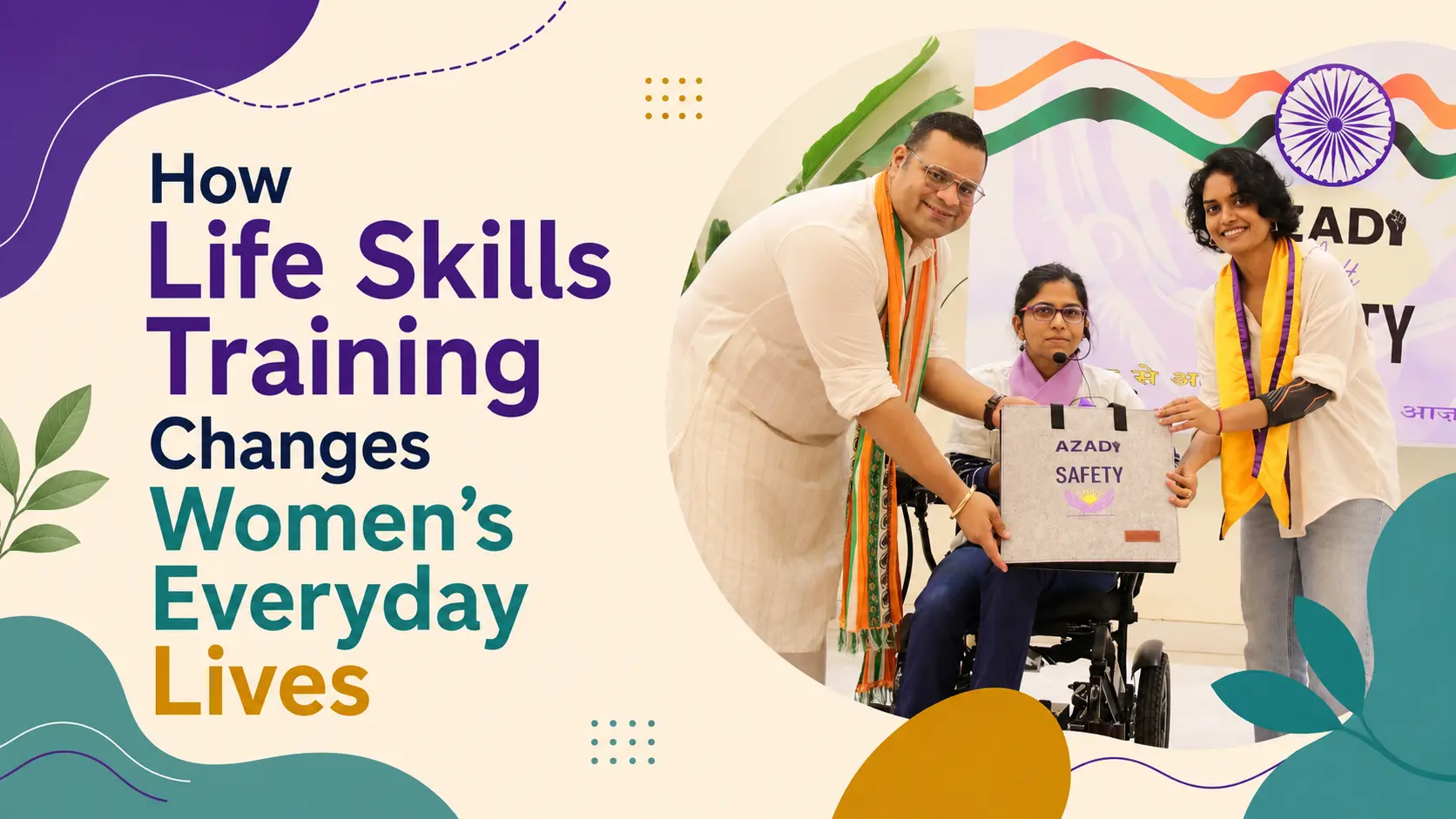
Earlier, she waited for someone else to make the phone call. To negotiate the price. To speak up at a meeting. To say no.
Now, she handles all of it herself. Not because anything dramatic happened overnight, but because someone finally showed her how.
It does not always begin with a defining moment. Sometimes, change unfolds quietly when a woman first speaks up for herself, takes charge of her own finances, or simply says “no” without hesitation. These are not small wins. They are powerful shifts. And more often than not, they rise from something deeply practical yet routinely overlooked: life skills training.
Across India, and especially within communities of differently abled women, access to the right skills often stands between dependency and independence. For an ngo working for women’s empowerment, this is far more than a program. It is a pathway to dignity, confidence, and control over one’s own life.
What Are Life Skills and Why Do They Matter
Life skills are not job skills. They are the unseen competencies that determine how a person responds to real life. The World Health Organisation defines them as abilities for adaptive and positive behaviour that allow individuals to meet everyday demands. These include:
- Decision-making and problem-solving that prepare women to face family and workplace pressure
- Communication and interpersonal skills that allow them to share needs without guilt
- Critical thinking that guards against manipulation and financial exploitation
- Emotional regulation that builds stronger relationships and mental health
- Self-awareness that redefines how women see their own value
For differently abled women, these skills hold even more weight. In a society that already limits access to education, employment, and public spaces, learning to advocate for yourself and manage your finances becomes the difference between dependence and dignity.
Why Life Skills Training Is Essential for Women Today
Under India’s Skill India Mission, over 1.2 crore individuals have been trained, and women form nearly 40% of those trainees. Still, participation on its own does not translate into empowerment.
This matters most for differently abled women, who confront compounding barriers. Mobility constraints, social stigma, and inaccessible infrastructure shut them out of basic opportunities. Life skills training cuts through that isolation, equipping them to navigate systems designed without them in mind.
| Factor | Traditional Skills Training | Life Skills-Integrated Training |
| Focus | Job-specific technical skills | Holistic personal and professional growth |
| Confidence building | Minimal or absent | Core component |
| Financial literacy | Rarely included | Actively taught |
| Support for differently abled women | Often inaccessible | Designed with inclusion in mind |
| Long-term independence | Limited to employment | Extends to all areas of daily life |
Everyday Changes Women Experience After Life Skills Training
The real proof is not in programme reports. It surfaces in kitchens, classrooms, and bank queues:
- They speak up at home. Sharing opinions during family decisions rather than staying silent. Differently abled women start telling carers what support they truly need instead of accepting whatever is given.
- They handle finances differently. They open savings accounts, track expenses, and refuse to surrender earnings without question.
- They negotiate. In markets, in workplaces, with landlords and doctors. Differently abled women learn to negotiate for reasonable accommodations rather than settling for exclusion.
- They recognise manipulation. After training, women see through coercion sooner, whether from family members, employers, or strangers online.
- They support other women. A pattern that surfaces again and again: women who receive training pass it on to neighbours and peers. This ripple effect is how real women’s empowerment in India scales.
For differently abled women, the impact runs deeper still. They move from being treated as dependent to being acknowledged as capable individuals with their own voices and ambitions.
And that shift? It changes everything.
The Role of Organisations Like Almawakening as an NGO for Women
This kind of transformation does not happen in isolation. It demands structured support, consistent effort, and a genuine understanding of the challenges women face.
That is the role organisations like us at Almawakening play.
As one of the women’s empowerment organisations focused on meaningful impact, Almawakening looks past surface-level programmes. We partner with differently abled women to shape training that is the following:
- Accessible – Shaped around varied needs and abilities
- Practical – Grounded in real-life application, not theory
- Empowering – Designed to build confidence and independence
- Inclusive – Leaving no woman behind
Our work in skills training for women is not a tick-box exercise. It is about creating long-term change.
By weaving life skills education with emotional support and community engagement, we help women.
- Recognise their strengths
- Build self-worth
- Step into opportunities they once believed were beyond their reach
Equally important, we do this while reshaping how society views differently abled individuals, not as limitations but as people with distinct capabilities.
Small Skills, Big Life Changes
A woman with the ability to manage a household budget is claiming authority over her own life. A differently abled woman with the ability to articulate her rights to an employer is dismantling the assumption that she cannot.
Life skills training does not produce a sudden, dramatic transformation. It produces steady, irreversible change that builds across weeks and months, until the woman who once waited for permission begins to make her own decisions.
Organisations such as Almawakening Foundation are showing what happens when investment flows into life skills education for women: the trajectory of entire families and communities shifts.
Eager to join the change? Connect with Almawakening Foundation today to volunteer, donate, or partner with a movement redefining the meaning of empowerment.