
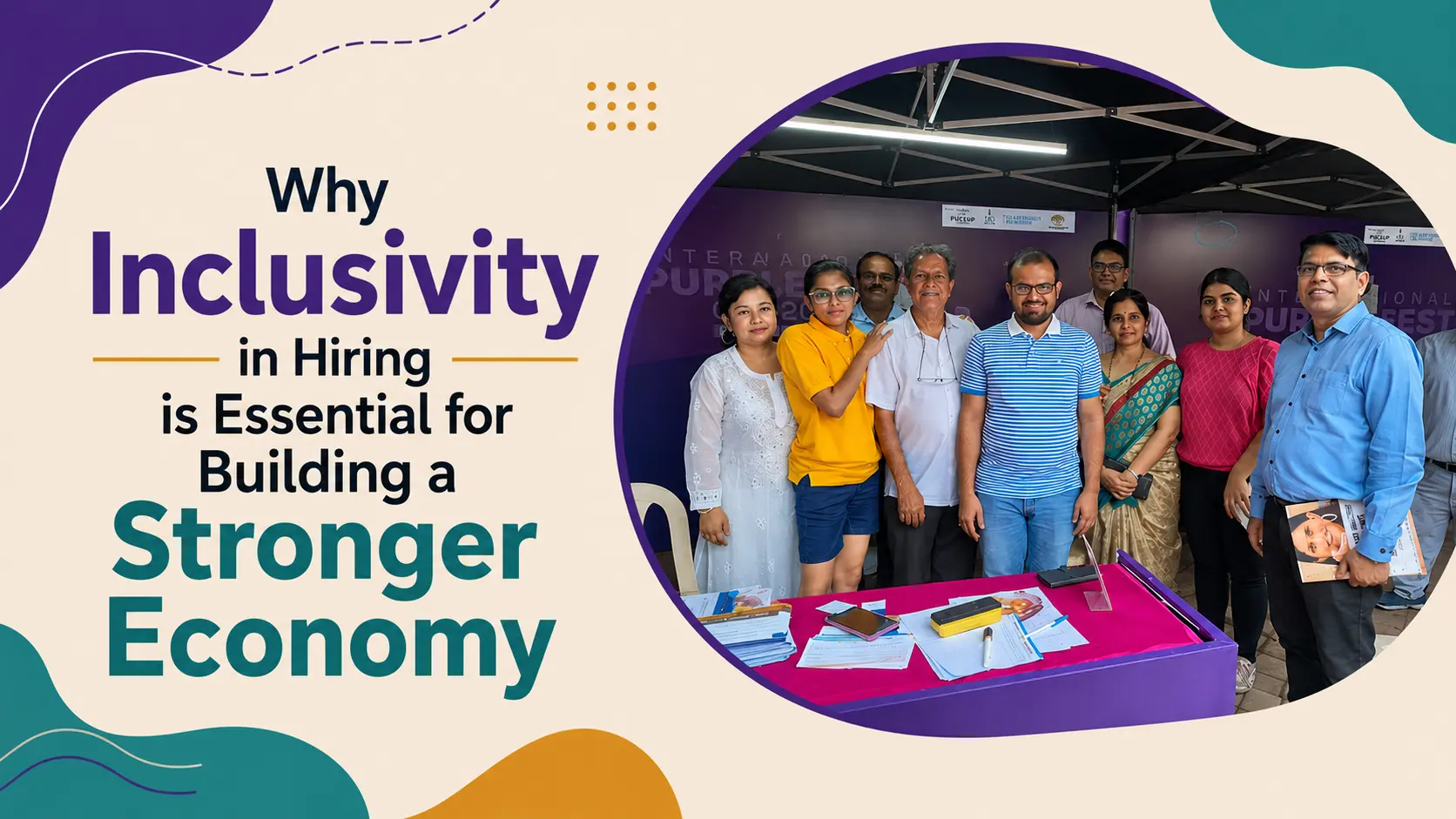
Step into any workplace today, and the word “diversity” comes up frequently. Yet the deeper question remains: are we actually creating space for everyone to participate, contribute, and grow?
Inclusive hiring goes beyond filling quotas or checking boxes. It calls for rethinking how we define talent, who gets access to opportunities, and how organisations can foster environments where people from all backgrounds, including differently abled individuals, can thrive.
Truly inclusive hiring does not just transform companies. It reshapes economies, communities, and lives. Yet so many companies are still getting it wrong. The real question is what happens when they get it right?
What is Inclusive Hiring?
In simple terms, inclusive hiring is a recruitment approach designed to offer equal employment opportunities to every individual, regardless of their background, identity, or abilities. It extends beyond traditional hiring practices by working to remove barriers that might keep qualified candidates from entering or succeeding in the workforce.
This includes:
- Designing accessible application processes
- Eliminating bias in screening and interviews
- Actively reaching out to under-represented groups
- Creating roles and environments where differently abled individuals can perform at their best
Inclusive hiring is not charity. It is a strategic decision. It means recognising that talent exists everywhere, even when it has not always had equal access to the same platform.
Economic Benefits of Diversity and Inclusion in the Workplace
Let us talk numbers. This is usually where sceptics go quiet. Companies that champion racial diversity in the workforce and actively hire differently abled professionals consistently outperform their competitors. That translates into smarter decisions, better innovation, and stronger business performance.
Here is how inclusive hiring delivers real economic value:
- Reduced turnover rates, as employees show a 35% lower risk of leaving
- Improved job performance, with research revealing a 22% increase in output
- More robust innovation pipelines, where cognitive diversity and AI drive team creativity up to 40%
The takeaway? Differently abled professionals are not simply capable. They are often among the most dependable, resourceful, and safety-conscious members of any team.
Inclusive hiring is not a cost. It is an investment that generates compounding returns.
How Inclusivity in Hiring Expands the Talent Pool
There is a hard truth most recruiters would rather not face: traditional hiring filters are broken. Rigid degree requirements, inaccessible application portals, narrow job descriptions, and interview formats that favour one type of candidate over another. Each of these quietly closes the door on extraordinary people.
The differently abled community represents one of the largest untapped talent pools on a global scale. As the United Nations highlights, the unemployment rate among differently abled individuals of working age is roughly double that of their peers. The reason is not a shortage of skill or ambition. It is that the systems around them were never designed to account for their needs.
So what are forward-thinking organisations doing differently?
- They write inclusive job descriptions that focus on outcomes, not physical assumptions. Rather than “must be able to stand for long periods”, they use “must be able to remain at a workstation”.
- They offer interview accommodations upfront, allowing every candidate to show up as their best self.
- They invest in flexible and remote work options. A Deloitte study found that this approach increases workforce diversity by 17%.
- They adopt skills-first hiring models, focusing on what people can do rather than where they earned their degrees.
When you remove artificial barriers, you do not lower the bar. You open up the field. And before long, you are selecting from a richer, more qualified, and more diverse set of candidates than ever before. That is how inclusive hiring shifts recruitment from a bottleneck into a true competitive advantage.
Reducing Social Inequality Through Inclusive Hiring Practices
Inclusive hiring goes beyond being a business strategy. It is a social equaliser.
When a company welcomes a differently abled professional or someone from a marginalised community, it sends a powerful signal. It says: your potential matters more than your circumstances.
The impact of this extends far beyond the office walls. Differently abled individuals who find stable employment gain greater financial independence, stronger mental well-being, and deeper community integration. Their families benefit. Their neighbourhoods benefit. The local economy benefits. Inclusive hiring practices directly drive social and economic inclusion on a scale that policy alone cannot achieve.
And it influences workplace culture in significant ways:
- Colleagues working alongside differently abled professionals build greater empathy and a clearer understanding of accessibility.
- Teams become sharper problem-solvers when they include people who navigate a world not built for them every single day.
- Organisations gain real credibility from customers and communities who recognise that their values extend beyond words on paper.
Racial diversity in the workforce follows the same principle. When hiring practices mirror the full spectrum of society, they dismantle the systemic barriers that shut talented people out of opportunity. Inclusive hiring does not just fill roles. It reshapes the rules of who gets to participate and who gets to lead.
Conclusion: Inclusivity in Hiring for a Stronger, Prosperous Economy
Here is what it really comes down to. Inclusive hiring is not a choice anymore. It is a necessity. The companies that succeed in the years ahead will not be the ones with the most refined employer branding.
They will be the ones who truly see people. All people. Including the differently abled professionals, the underrepresented voices, and the overlooked talent that traditional systems were never built to reach.
Inclusive hiring is not a passing trend. It is the bedrock of a stronger, more innovative, and more equitable economy. It turns equal employment opportunities from a slogan into something people actually experience.
The question is no longer whether inclusive hiring matters. It is whether your organisation is willing to act on it. Ready to build a more inclusive future? Reach out today to schedule a consultation or request a custom quote. Together, we can break every barrier.