
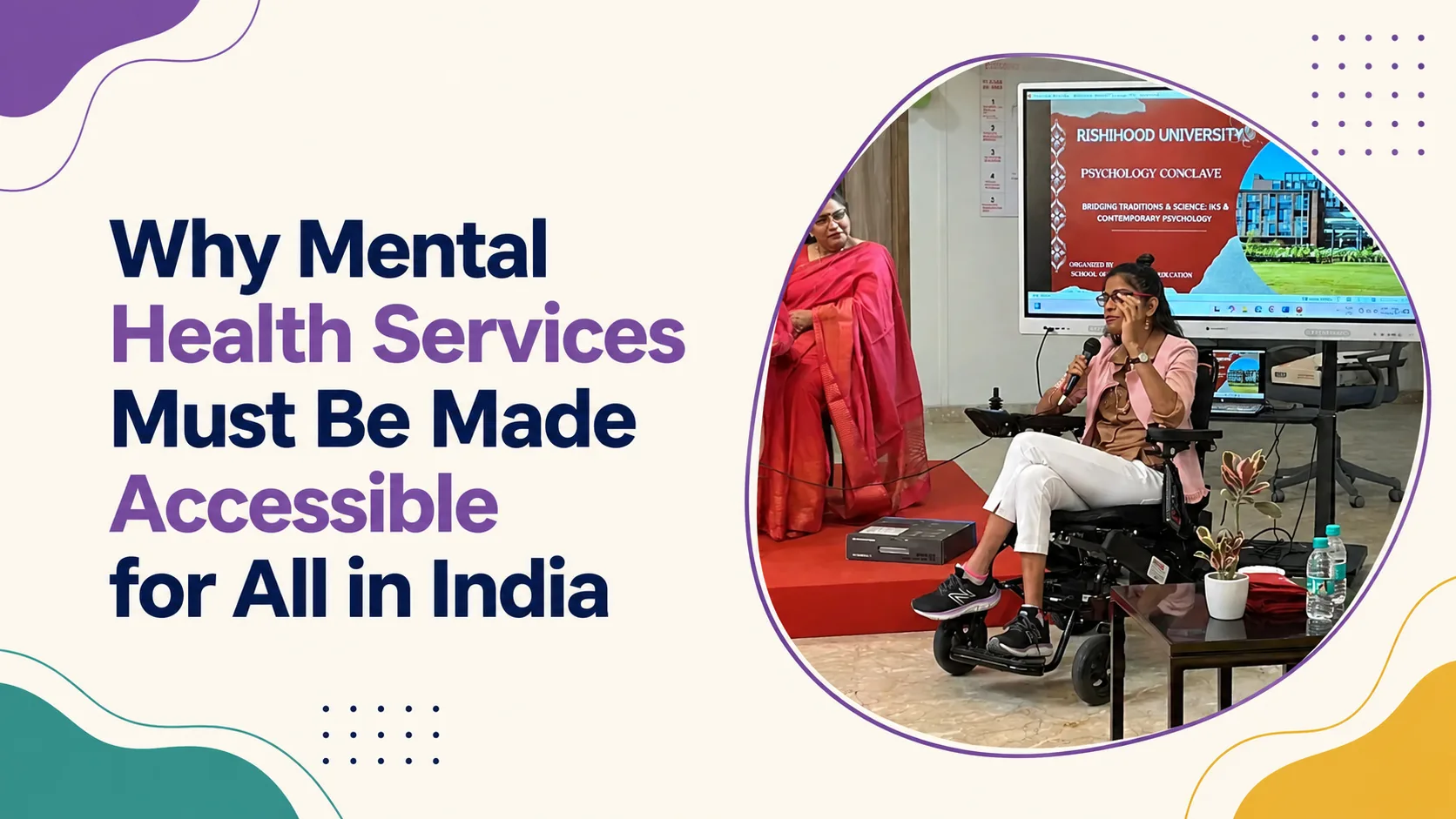
With a population of 1.4 billion, India carries an enormous and largely unmet mental health burden. For a staggering majority, access to mental health support remains a general, almost abstract idea. The need is real and well-documented. What is missing are the systems capable of addressing it, systems that are either inaccessible, underfunded, or absent entirely.
India is home to 1.4 billion people, and yet for a staggering majority, mental health support remains a general, almost abstract idea. The need exists without question. The systems designed to meet that need, however, are largely inaccessible, chronically underfunded, or altogether absent. In this blog, we will address why mental health services should be made accessible in India.
The Need for Accessible Mental Health Services in India
India is facing a serious mental health crisis, and the numbers make that difficult to ignore. The National Mental Health Survey by NIMHANS found that almost 10.6% of adults in the country live with some kind of mental health issue. Yet the treatment gap sits between 70% and 92%, a figure that reflects just how many people who need care are going without it.
The numbers tell a difficult story.
- India’s psychiatric workforce stands at fewer than 0.75 psychiatrists per lakh of the population, well below the WHO’s recommended minimum of 3.
- The situation is particularly stark in rural India, where nearly 70% of the country’s population resides, and mental health awareness remains deeply inadequate.
- Stigma forces millions into silence. Families hide what should not have to be hidden. Individuals bear their suffering alone. Communities continue to look the other way.
- Differently abled individuals, who already navigate a world not designed for them, face even steeper barriers when it comes to accessing psychological support.
The Economic Survey 2023-24 acknowledged mental health as a critical driver of national development for the very first time. Progress, certainly. But acknowledgment alone does not heal anyone.
Why Mental Health Services Should Be Accessible for All
True accessibility in mental health services goes well beyond increasing the number of clinical facilities. What matters is who the system prioritizes, how meaningful reach is established, and which communities remain systematically underserved.
Differently abled persons in India are not navigating a single, uniform struggle. The challenges they face are physical, sensory, and intellectual, but layered on top of those are social isolation, discrimination, and a healthcare system that has historically paid little attention to emotional well-being. Despite this, mental health support that truly meets their unique needs remains far too limited.
Someone managing a locomotor condition may discover that their nearest clinic offers neither ramp access nor sensitivity-trained staff. For individuals on the autism spectrum, the persistent absence of specialised approaches leaves them more likely to be dismissed than genuinely supported.
True accessibility means:
- All facilities are designed with physical accessibility as a core priority, enabling individuals with mobility-related conditions to navigate the spaces without barriers.
- Therapy materials and counselling are offered in sign language, Braille, audio, and easy-to-read formats to support every individual’s preferred mode of communication.
- Professionals are trained across the full spectrum of physical, sensory, cognitive, and mental health.
- Digital platforms grounded in universal accessibility standards from the very start.
NGOs Promoting Mental Health Access
In areas where public infrastructure proves insufficient, non-governmental organisations have taken on the responsibility of bridging those critical gaps.
At the Almawakening Foundation, mental health support is not a standalone pillar; it is woven into everything we do around inclusion and empowerment. Our Health and Well-Being initiative rests on one clear and powerful belief: that healthier communities develop through preventive healthcare, awareness sessions, and accessible support services. Healthier communities do not happen by accident. They are built on preventive healthcare, awareness sessions, and accessible support services, and those are exactly what our Health and Well-Being initiative is designed around.
The reach of mental health services has grown considerably through government initiatives like TeleMANAS, a program running 53 cells across 36 states and union territories in more than 20 languages. Digital platforms such as Wysa and YourDOST are further bridging the gap by making counselling more accessible to younger populations and working professionals.
The true measure of NGO-led efforts lies in community outreach, school programs, and grassroots workshops, which serve as the foundation for a culture in which reaching out for help is no longer associated with weakness.
Role of Society in Improving Mental Health Accessibility
Policy matters, without question. But sustainable change requires something broader: it requires society itself to decide that mental health is worth prioritising.
This kind of change does not happen in isolation.
- Schools must embed mental health education within their curriculum so that emotional well-being becomes a familiar and normalised part of childhood development.
- Workplaces must invest in wellness programmes that are substantive and thoughtfully designed, moving well beyond symbolic gestures that offer little real support.
- Media and public figures must continue pushing the conversation forward on mental health, especially for differently abled communities that have long been underserved in these discussions.
- Local communities must evolve into genuine safe spaces, where dialogue flows openly, peer support is accessible, and early intervention is never too far away.
The Mental Healthcare Act of 2017 secures the right to accessible, affordable mental health care for every Indian citizen. The real measure of that legislation, though, lies in whether communities choose to demand that it actually be implemented.
The Path Toward Universal Access to Mental Health Services
The progress India has made in this area is undeniable. Over 90% of revenue districts now fall under the District Mental Health Program, with more than 1.73 lakh health centres running mental health services at the ground level. The Tele-MANAS helpline has fielded over 2 million calls since launch, a number that speaks for itself.
Closing the mental health gap in India, however, requires a deliberate commitment to the following:
- Addressing critical gaps in mental health service delivery starts with the workforce. Scaling to the WHO-recommended standard of 3 psychiatrists per 100,000 people is a baseline, not a ceiling.
- All healthcare facilities must be evaluated against recognised accessibility standards and upgraded accordingly. Differently abled individuals deserve access to essential mental health care, and current gaps in facility readiness make that access unreliable.
- Expanding teletherapy platforms without prioritising robust accessibility features, including comprehensive compatibility with assistive technology, means leaving a significant portion of the user spectrum behind.
- Long-term, holistic outcomes in mental health require more than clinical intervention. Sustained investment in community-based rehabilitation, especially programs that pair mental health with social empowerment, is what makes that broader impact possible.
The way we approach mental health must evolve. Treating it as a niche concern ignores its role as a foundational pillar of public health, productivity, and human dignity. Recognising that reality is where meaningful progress begins.
Summing Up
Mental health is a fundamental right, not a luxury. Yet for far too many people across India, access to quality mental health support remains an unmet need. That gap is precisely why the work continues.
Whether you or someone close to you is dealing with emotional stress, seeking clarity, or looking for a compassionate ear, the right support is available to you.
Contact us today to schedule a consultation or request a custom quote and begin your path toward care built around your needs.